


The Global Trailer Manufacturing Standards Guide
Navigating global trailer standards (ISO, DOT, ECE) is crucial for quality and compliance. Discover how Maral Sanat Javid adheres to these critical regulations to guarantee structural safety, maximum durability, and seamless international operation.
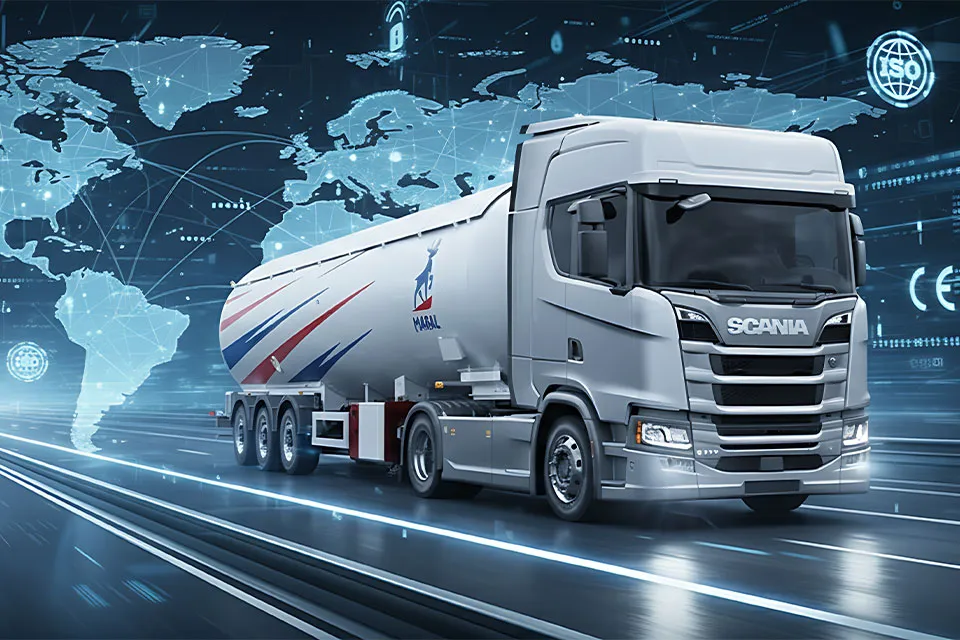
Beyond the Road: Decoding the Global Manufacturing Standards for Trailers
The world of logistics moves at the speed of commerce, and the backbone of this massive operation is the commercial trailer. These vehicles are not merely steel containers on wheels; they are sophisticated, engineered assets subject to some of the most rigorous and essential quality checks in the industrial sector. Ignoring these regulations isn't just risky—it’s non-compliant, dangerous, and a direct threat to your business continuity.
At Maral Sanat Javid (MSJ), we recognize that operating successfully in the international market demands a profound commitment to quality that transcends local rules. Compliance with Global Trailer Manufacturing Standards is the non-negotiable foundation of safety, durability, and commercial success, ensuring that our products can be seamlessly integrated into fleets operating in the Americas, Europe, Asia, and beyond.
This comprehensive guide is designed to help stakeholders navigate the complex regulatory landscape, detailing how vital benchmarks like ISO 9001 (Quality Management), regional requirements such as DOT compliance (for the U.S. market) and ECE regulations for trailers (for the EU and international adoption), and specific trailer structural design criteria dictate a trailer’s true value and longevity. Are your trailers built to truly global quality benchmarks? Join us as we break down the essential standards that define excellence in global trailer manufacturing.
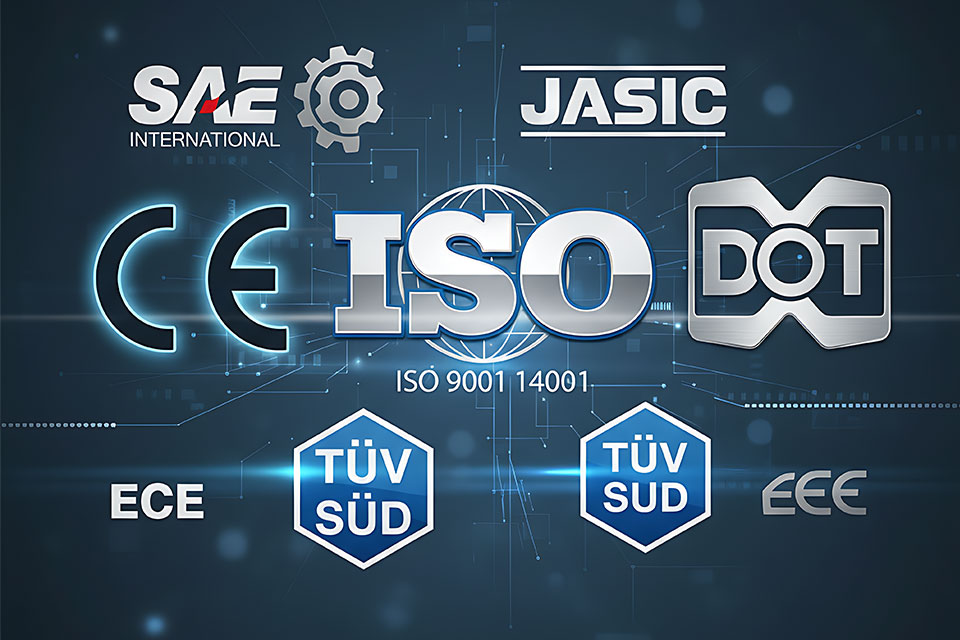
The Pillars of Global Compliance: ISO Standards
The International Organization for Standardization (ISO) provides a foundational framework for quality management and production consistency, which is crucial for achieving superior trailer structural design. While not always legally binding for road use, these standards are fundamental to a manufacturer’s reputation and reliability.
- ISO 9001 (Quality Management): This is the gold standard for any global manufacturer. A compliant company ensures that every procedural step, from material sourcing and supplier management to final assembly and quality inspection, meets a consistent quality threshold. This minimizes defects, streamlines production, and drastically improves long-term product reliability.
- ISO 14001 (Environmental Management): Increasingly important in the global supply chain, this standard dictates environmentally responsible manufacturing practices, ensuring sustainability and resource efficiency in the production process of heavy vehicles.
- ISO 3834 (Quality Requirements for Welding): Given that welding is the structural backbone of trailer integrity, compliance with ISO 3834 ensures that all critical structural welds meet rigorous strength, penetration, and quality specifications, directly contributing to safe payload limits and longevity.
Regional Safety Regulations: DOT and ECE
While ISO focuses on quality processes, governmental and regional bodies enforce specific trailer safety regulations for legal road operation. For a trailer to be globally marketable, it often needs to satisfy multiple regional requirements. Regional Safety Regulations: DOT and ECE
While ISO focuses on quality processes, governmental and regional bodies enforce specific trailer safety regulations for legal road operation. For a trailer to be globally marketable, it often needs to satisfy multiple regional requirements.
|
Regulatory Body |
Key Area of Focus |
Geographical Scope |
|
DOT (Department of Transportation) |
Braking systems, lighting, conspicuity markings, and vehicle identification (VIN). Compliance with DOT compliance is mandatory for entry into the highly competitive U.S. market. |
United States |
|
ECE (Economic Commission for Europe) |
Whole Vehicle Type Approval, braking systems (ABS/EBS), tires, and exterior lighting/signaling. Often referred to as ECE regulations for trailers, these standards are mandatory across the EU and widely accepted by many countries globally as a mark of safety. |
European Union & many Non-EU trading nations |
The MSJ Advanta
The MSJ Advantage: A truly global trailer must satisfy the stringent requirements of both the New World (DOT) and the Old World (ECE), a commitment that defines the engineering philosophy at Maral Sanat Javid.
Critical Technical Standards for Durability: Engineering for Extremes
Beyond bureaucratic mandates, a trailer's true quality is defined by its compliance with specific technical standards that dictate the physical reliability and operational safety of the equipment under stressful, long-haul conditions. These standards are the foundation of engineering excellence.
Materials Science and Rigorous Load Testing
- Yield Strength and Fatigue Resistance: International material standards rigorously define the minimum yield strength and fatigue resistance for all primary chassis materials, such as high-grade, lightweight structural steel. This is non-negotiable, as it directly impacts the trailer's ability to withstand repeated stress cycles and prevent catastrophic failure over its lifespan.
- Payload Capacity Verification: Manufacturers must conduct rigorous static and dynamic load and fatigue testing. This involves simulating extreme operating conditions—including sudden braking, cornering forces, and prolonged vibration—to verify that the trailer's declared payload capacity is not only safe but also verifiable and compliant with global loading protocols. This ensures that the trailer structural design will not fail prematurely.
Advanced Braking System Requirements (ABS/EBS)
Modern trailer manufacturing standards demand braking systems that maximize control and prevent jackknifing or loss of stability, especially when fully loaded.
- Electronic Braking Systems (EBS): The standard has shifted toward EBS, which offers a much faster response time and better load-apportionment capability than traditional air-brake systems. EBS significantly enhances vehicle stability and shortens stopping distances, which is a critical component of global trailer safety regulations.
- Anti-lock Braking Systems (ABS): This fundamental requirement ensures that wheels do not lock up during severe braking, allowing the driver to maintain steering control. All systems must comply with specific regional performance requirements dictated by bodies like DOT and ECE.
Axle, Suspension, and Coupling Performance
The running gear is constantly under stress and is vital for safe operation and load protection.
- International Rating: Axles, multi-axle suspension systems (air and mechanical), and coupling devices (kingpins) must be rated according to stringent international standards. These ratings ensure they can reliably handle the intended load (GAWR – Gross Axle Weight Rating) and withstand the continuous shock and vibration encountered on diverse global road networks without premature failure.
- Kinematic Testing: Standards require testing of suspension geometry and alignment to ensure optimal tire wear, fuel efficiency, and safe handling characteristics under various loading scenarios.
The Role of Quality Control in Trailer Manufacturing: From Steel to Road
Meeting these vast and complex Global Trailer Manufacturing Standards is not a one-time approval; it is an integrated, continuous process woven into the fabric of the production line. Effective quality control in trailer manufacturing involves meticulous checks at every phase, ensuring traceability and accountability.
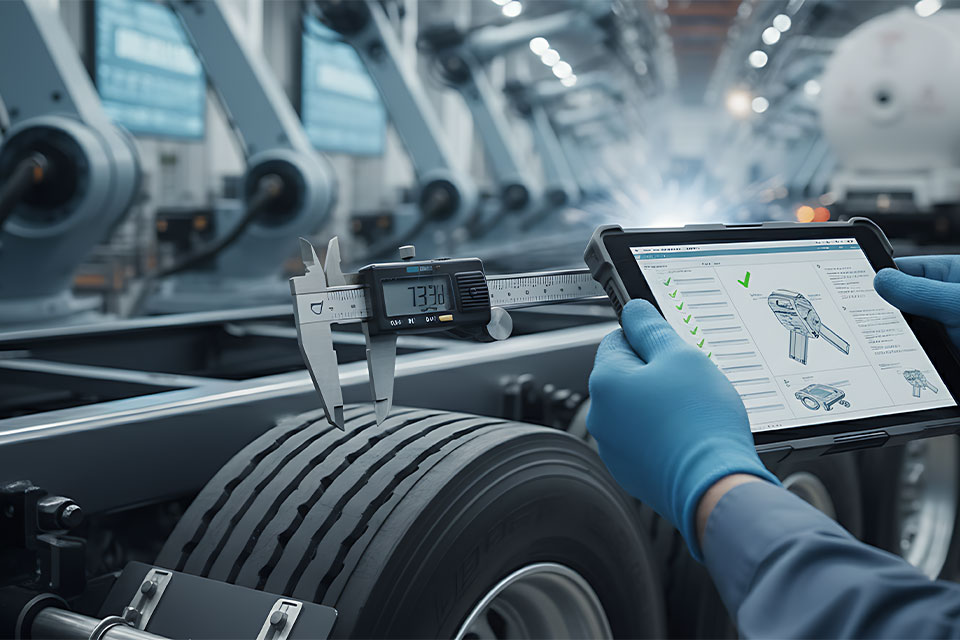
Meticulous Checks Across the Production Lifecycle
- Material Inspection and Traceability: The process begins with certifying incoming steel, aluminum, and components. Materials must be verified against purchase orders and specifications, ensuring they meet the minimum required strength and alloy content. Material traceability is maintained throughout the build process, a key requirement of ISO-compliant production.
- Process Verification and Welding Audits: Regular internal and external audits are performed on all critical fabrication processes. This includes maintaining strict adherence to ISO 3834 for welding procedures, ensuring welders are certified, and performing Non-Destructive Testing (NDT) such as ultrasonic or magnetic particle inspection on structural seams.
- Final Testing and Documentation: Every finished unit undergoes comprehensive pre-delivery checks. This includes brake efficiency tests, pressure checks on air lines, functionality tests for lighting systems, and verification of dimensional integrity (length, width, alignment). Complete documentation is prepared for the client, confirming full adherence to relevant DOT compliance or ECE regulations for trailers.
- Maral Sanat Javid's Pledge: Our commitment is built on more than steel—it's built on verified standards. We integrate these global standards—from the initial selection of high-grade steel to the final, comprehensive road-readiness test—to ensure every MSJ trailer delivers unmatched performance and adheres to the highest trailer safety regulations worldwide. Our continuous commitment to ISO, DOT, and ECE compliance is your absolute guarantee of quality and dependability.
Conclusion: Your Guarantee of Global Quality
In an industry where safety and uptime are paramount, adherence to Global Trailer Manufacturing Standards is the ultimate differentiator. These regulations—from the internationally recognized ISO 9001 to the critical regional mandates like DOT compliance and ECE regulations for trailers—are not obstacles; they are the benchmarks of professionalism and reliability.
By choosing a manufacturer that rigorously upholds these standards, you are investing in a product that guarantees maximum durability, reduces liability risks, and ensures seamless cross-border operation. Maral Sanat Javid is committed to exceeding these global benchmarks, delivering trailers engineered for the demands of tomorrow’s logistics.
Don't just buy a trailer; invest in certified global excellence.

Ready for Global Performance?
Choosing a trailer that meets all relevant Global Trailer Manufacturing Standards is an investment in safety, compliance, and longevity. Don't compromise your fleet's future.
Contact the Maral Sanat Javid experts today to discuss how your next trailer is engineered and built to the highest global quality benchmarks.
Faq
Top Articles
Modern Technologies Revolutionizing Trailer Axle Manufacturing
Modern trailer performance relies on advanced axles. We explore innovations in axle production that enhance fuel economy, reduce maintenance, and ensure superior road safety.
Brake Battle: Disc vs. Drum
Compare Disc Brakes vs Drum Brakes for heavy-duty vehicles. Understand pros, cons, and impact on performance, safety.
Your Ultimate Guide to Trailer Axle Types and Technical Specs
Trailer axles are the unsung heroes of heavy-duty transportation, directly impacting safety, load capacity, and operational efficiency. Choosing the wrong axle type can lead to costly downtime and compromised performance.